Sourdough Loaves
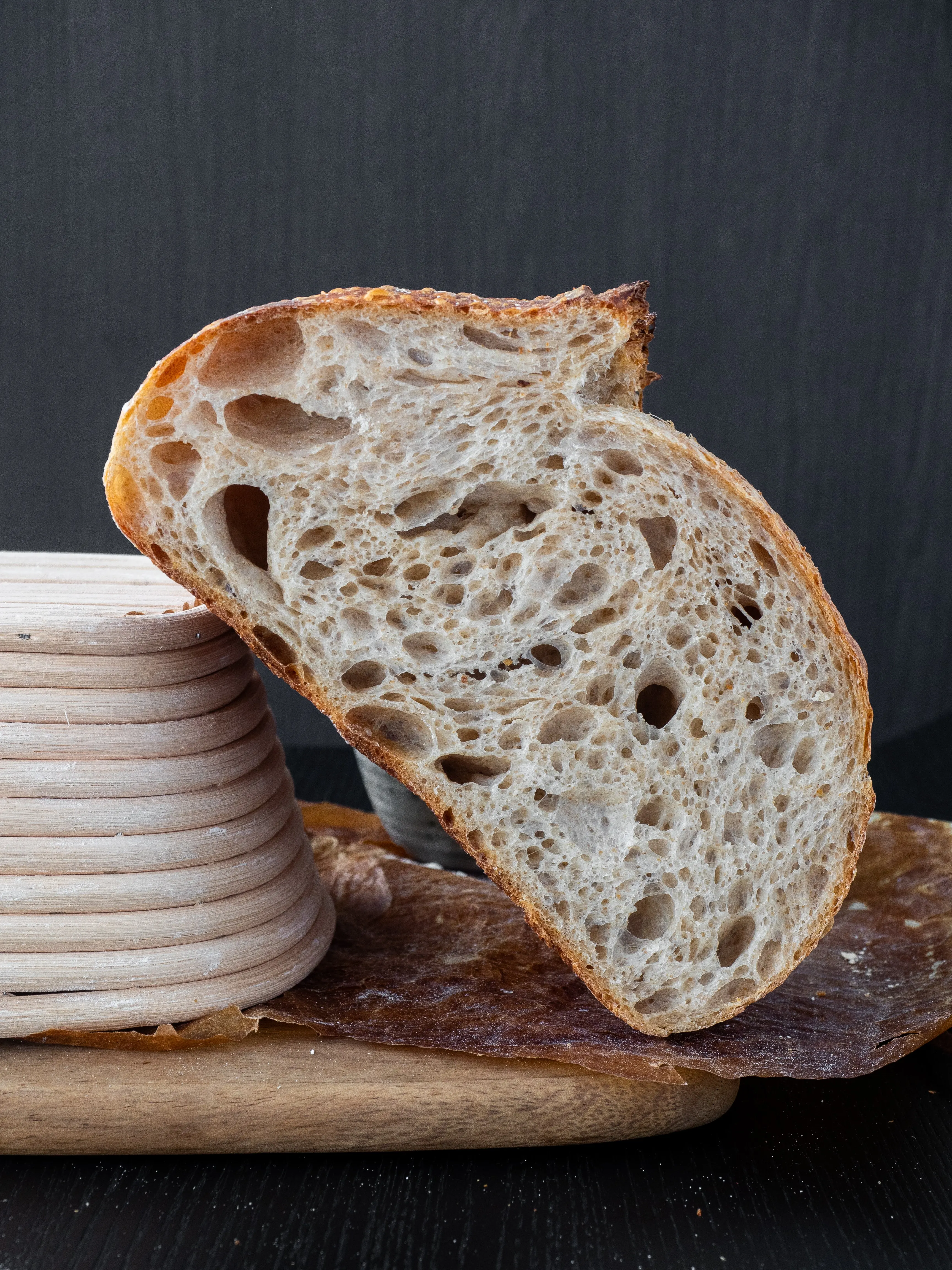
What you’ll need
When baking bread, it’s typical to use baker’s percentages (more information about bakers percentages below) as this allows the recipe to be easily tweaked.
I tend to keep the salt percentage between 1.8% - 2% and the sourdough starter to 10% - 20%. For water I’ll use anywhere between 66% and 74%. The less water in the dough, the easier it will be to work with. If you add too little water however, the dough will start to become tough and dense. For this reason I generally don’t go below 66% unless its for a specific recipe (such as bagels).
- Bakers/bread flour (this is important otherwise your dough might not develop enough structure and be sticky). You can also sub out a percentage of the bread flour for an alternative such as wholemeal, spelt or rye.
- Water (ideally between 30°C - 35°C)
- Sourdough starter
- Salt
- Rice flour for dusting the shaped loaf (semolina wholemeal or white flour will do but rice flour is the best)
For a typical loaf I’ll use the following measurements:
| Ingredient | Weight | Percentage |
|---|---|---|
| Bread flour | 500g (1 loaf) | 100% |
| Water | 330g | 66% |
| Salt | 10g | 2% |
| Sourdough starter | 80g | 16% |
The more sourdough starter you add, the quicker the dough will ferment. As the dough ferments for longer it will become more sour, so if you prefer a less sour loaf, add more starter to speed up the process.
Method
Mixing and kneading
This approach will take around 1.5 days to complete with the bulk of the effort on the first day, and the second just for baking.
Feed your starter the night before you intend to cook, it should be live and active before you begin baking. In the colder months you’ll need to start this recipe in the morning to allow enough time for bulk fermentation.
Add all the ingredients into a large bowl and bring it together into a shaggy clump. You then need to develop the gluten in the dough, you can do this one of 3 ways:
- Knead knead knead! Once you’ve mixed the dough together into a shaggy clump, turn it out on to the bench-top and knead.
- Use a stand mixer: Put the dough in a stand mixer bowl and using the dough hook, knead on a low speed until the gluten is sufficiently developed.
- Knead, rest, repeat: Firstly knead for only a minute or two to begin to develop some strength and then leave it covered for around 10 minutes. Repeat this 2 - 4 times until the dough is strong enough
For all of these methods, you’ll know you’ve developed enough gluten when the dough passes the window pane test.
Bulk fermentation
Once your dough has developed enough strength, put it in a container, cover and set aside for the bulk fermentation stage. The amount of time required for bulk fermentation is highly dependant on the ambient temperature. The best indicator for when the dough is ready to shape is when it has doubled in size. This will likely take anywhere upwards of 4 hours.
Shaping
When the dough has doubled in size turn it out onto a lightly floured surface for shaping. It is highly recommended to get a dough scraper for this stage as it will make the shaping process much easier.
Rather than trying to explain the shaping process, there are plenty of videos and approaches demonstrating it. The following video is a good demonstration of the process for shaping a boule including pre-shaping:
Once shaped, place the dough into a rice flour lined banneton (proving basket) seam side up.
Note: if you don’t have a banneton you can use a tea towel lined mixing bowl that is liberally floured to avoid sticking
Cover with a tea towel and place in the fridge to sit overnight.
Baking
The following day check the dough has been proofed to the right level. Lightly press a finger into the dough, making a small dimple:
- If the dough bounces back quote quickly and there is little or no dimple left, it still needs more time to prove.
- If it doesn’t bounce back at all, then the dough is over proofed (this can still be cooked but you won’t get much of a rise in the oven).
- If the dough bounces back a bit, leaving the dimple, then it’s ready to bake.
Preheat your oven to 230°C and place in your dutch oven (with it’s lid). For the best result, preheat for at least half an hour to give the dutch oven time to come up to temperature.
When the oven is up to temperature, turn the loaf out onto a sheet of baking paper, seam side down. With a razor blade (or sharp knife if you don’t have a razor blade), confidently score the dough. This will give a place for the bread to expand. For more in depth information on scoring, this video is a useful resource.
Take the dutch oven out of the oven and carefully place in the scored dough (with the baking paper). Put the lid back on and return to the oven.
Cook with the lid on for 20 minutes, then remove, lower the temperature to 200°C and cook for a further 25 - 35 minutes until the crust is golden brown all over.
Once cooked, remove from the oven and leave to cool on a wire rack for at least an hour, this is really important. If you cut into the bread before it is properly cooled, it’ll release all it’s steam and result in an overly dry loaf of bread.